
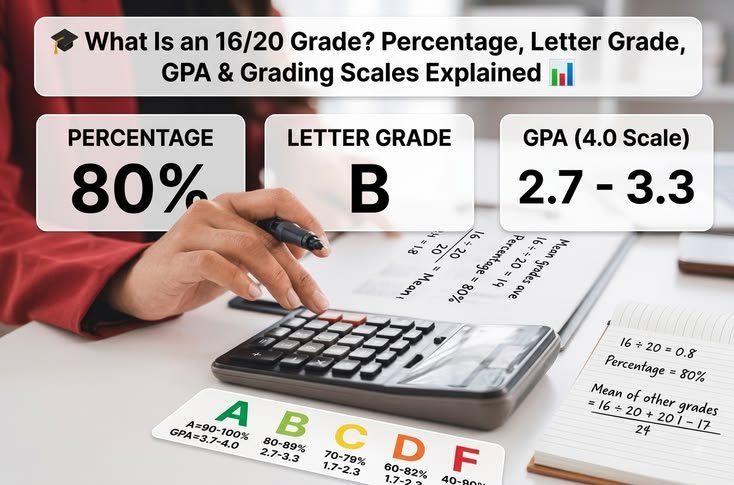
Students familiar with the American-style 4.0 GPA scale often need to translate their grades into a percentage figure — whether for an Indian employer, a government exam application, or simply to understand their academic standing in more familiar terms. Unlike CGPA-to-percentage conversion, which is built around officially published formulas, GPA-to-percentage conversion is inherently approximate, since the two systems weren’t designed to map onto each other precisely. This guide breaks down the standard conversion formula, a full reference chart across the entire 4.0 scale, worked examples, and the key limitations you should understand before relying on a converted figure for anything formal.
What Is the 4.0 GPA Scale?
The 4.0 GPA scale is the standard grading system used by most American high schools, colleges, and universities, and increasingly referenced by international institutions that interact with US-style transcripts. Under this system, a GPA of 4.0 typically represents a straight-A academic record, while lower values represent progressively weaker performance. Each individual course grade is assigned a numeric value — commonly A = 4.0, B = 3.0, C = 2.0, D = 1.0, and F = 0.0 — and a student’s overall GPA is the average of these values across all completed courses, often weighted by credit hours in the same way CGPA is calculated in the Indian system.
Why GPA-to-Percentage Conversion Is Approximate
Unlike CGPA, which has widely referenced formulas like CBSE’s 9.5 multiplier, GPA was never designed with an official percentage equivalent in mind. American institutions generally treat GPA as a complete, self-sufficient metric and rarely issue a corresponding percentage on an official transcript. Any GPA-to-percentage conversion you’ll find online, including the one on this page, is therefore a reasonable approximation based on common grading conventions, not a formula recognized or certified by any single educational authority. This distinction matters most when the converted figure is being used for something high-stakes, a point we’ll return to later in this guide.
The Standard GPA to Percentage Formula
The most widely used approximate formula for converting a 4.0 GPA into a percentage is:
Percentage ≈ GPA × 25
This formula is based on the simple proportional relationship between the two scales — since 4.0 is treated as the maximum GPA and 100% is the maximum percentage, dividing 100 by 4 gives a multiplier of 25, which scales any GPA value proportionally into percentage terms.
Worked Example
- Start with your GPA: 3.6
- Multiply by 25: 3.6 × 25
- Result: approximately 90%
Full 4.0 GPA to Percentage Conversion Chart
Below is a complete reference chart showing the approximate percentage equivalent across the full 4.0 scale, in increments of 0.1, using the standard GPA × 25 formula.
- GPA 4.0 → 100%
- GPA 3.9 → 97.5%
- GPA 3.8 → 95%
- GPA 3.7 → 92.5%
- GPA 3.6 → 90%
- GPA 3.5 → 87.5%
- GPA 3.4 → 85%
- GPA 3.3 → 82.5%
- GPA 3.2 → 80%
- GPA 3.1 → 77.5%
- GPA 3.0 → 75%
- GPA 2.9 → 72.5%
- GPA 2.8 → 70%
- GPA 2.7 → 67.5%
- GPA 2.6 → 65%
- GPA 2.5 → 62.5%
- GPA 2.4 → 60%
- GPA 2.3 → 57.5%
- GPA 2.2 → 55%
- GPA 2.1 → 52.5%
- GPA 2.0 → 50%
- GPA 1.5 → 37.5%
- GPA 1.0 → 25%
- GPA 0.5 → 12.5%
- GPA 0.0 → 0%
This chart is meant as a quick-reference guide. For a GPA value that falls between two listed increments, simply apply the formula directly for a precise figure, or use the calculator above for an instant result.
Letter Grade to GPA to Percentage Reference
Since GPA is built from individual letter grades, it helps to see how each grade maps through both GPA and its approximate percentage equivalent:
- A+ / A — GPA 4.0 → approximately 90–100%
- A- — GPA 3.7 → approximately 92.5% (or roughly 90–92%, depending on institution)
- B+ — GPA 3.3 → approximately 82.5% (or roughly 87–89%, depending on institution)
- B — GPA 3.0 → approximately 75% (or roughly 83–86%, depending on institution)
- B- — GPA 2.7 → approximately 67.5% (or roughly 80–82%, depending on institution)
- C+ — GPA 2.3 → approximately 57.5% (or roughly 77–79%, depending on institution)
- C — GPA 2.0 → approximately 50% (or roughly 73–76%, depending on institution)
- D — GPA 1.0 → approximately 25% (or roughly 60–69%, depending on institution)
- F — GPA 0.0 → below passing, institution-dependent
Notice the two different percentage ranges listed for several grades above. This isn’t a mistake — it highlights an important limitation of GPA-to-percentage conversion, covered in more detail below.
Why the Same Letter Grade Can Map to Different Percentages
One of the most important things to understand about GPA-to-percentage conversion is that individual American institutions set their own internal percentage ranges for each letter grade, and these ranges are not standardized nationally. One university might consider 93–100% an A, while another sets the threshold at 90–100%. This means a straightforward proportional formula like GPA × 25 gives a reasonable general estimate, but it won’t always precisely match the actual percentage range your specific institution used internally to assign that grade in the first place.
Step-by-Step: How to Convert Your GPA to Percentage
- Confirm your exact GPA value from your official transcript, including any decimal points
- Multiply your GPA by 25 to get an approximate percentage using the standard formula
- Round your result to one or two decimal places for a cleaner final figure
- Cross-check the result using our calculator above for an instant, error-free conversion
- If your application requires a precise, institution-verified percentage, consider requesting an official transcript notation or credential evaluation instead
Converting Percentage Back to a 4.0 GPA
The reverse calculation follows the same proportional logic, simply divided instead of multiplied:
GPA ≈ Percentage ÷ 25
Worked Example
- Start with your percentage: 85%
- Divide by 25: 85 ÷ 25
- Result: approximately 3.4 GPA
Converting a 4.0 GPA to Indian CGPA
Students moving between the American GPA system and the Indian CGPA system often need this conversion for admissions or employment purposes within India. A commonly used approximate formula is:
CGPA ≈ (GPA ÷ 4) × 10
Worked Example
- Start with your GPA: 3.4
- Divide by 4: 3.4 ÷ 4 = 0.85
- Multiply by 10: 0.85 × 10
- Result: approximately 8.5 CGPA
As with every cross-system conversion in this guide, treat this as a general estimate rather than an exact, universally recognized calculation.
When a Self-Calculated Conversion Isn’t Enough
For casual, low-stakes purposes — comparing your academic performance, filling in an informal profile, or simply satisfying your own curiosity — the standard GPA × 25 formula works well. However, for higher-stakes situations, a self-calculated percentage may not be sufficient:
- Government job applications in India that specify a strict percentage eligibility cutoff often require an officially certified conversion rather than a self-calculated estimate
- Visa and immigration applications frequently require a formal credential evaluation report rather than any self-converted figure
- Competitive scholarship committees may specify their own preferred conversion methodology, which should be followed instead of a generic formula
- University admissions, particularly for postgraduate programs, sometimes request an evaluation from a recognized credential assessment body rather than a student-submitted percentage
Common Mistakes When Converting GPA to Percentage
- Assuming the GPA × 25 formula is an officially recognized, universal standard rather than a general approximation
- Applying a 10-point CGPA-style formula directly to a 4.0 GPA value, which produces a meaningless result
- Ignoring that different institutions set different percentage ranges for the same letter grade
- Using a self-calculated percentage for a high-stakes visa or government application without checking whether official evaluation is required
- Rounding your GPA before multiplying, rather than rounding only the final percentage result
Tips for Presenting Your GPA on Indian Applications
- List your original GPA alongside the converted percentage, so recruiters or admissions staff can cross-verify the figure against the source scale
- Note the conversion formula used directly on your application or resume if space allows, for full transparency
- Where possible, attach your official transcript rather than relying solely on a converted number, especially for formal submissions
- For strict eligibility cutoffs, check whether the requesting body has published its own preferred GPA-to-percentage methodology before using a generic formula
Frequently Asked Questions
Is a 4.0 GPA equal to exactly 100%?
Under the standard proportional formula, yes, 4.0 maps to 100%. However, this is a mathematical approximation rather than a certified academic equivalence, since GPA and percentage are fundamentally different measurement systems.
Why do online GPA converters sometimes give slightly different results for the same GPA?
This usually comes down to which underlying assumption the calculator uses — some apply the simple GPA × 25 formula, while others use institution-specific grade-range mappings, which can produce a noticeably different result for the same GPA value.
Can I use a converted percentage on a government job application in India?
Some applications accept a self-calculated conversion, but many with strict percentage-based eligibility cutoffs require an officially certified equivalence. Always check the specific application’s requirements before submitting a self-converted figure.
Does this formula apply to a weighted GPA that includes honors or AP courses?
Weighted GPA scales, which can sometimes exceed 4.0 to account for advanced coursework, don’t map cleanly onto this standard formula. If your GPA is weighted, it’s worth clarifying with your institution whether an unweighted GPA figure should be used for percentage conversion instead.
Final Thoughts
Converting a 4.0 GPA into a percentage comes down to a simple proportional formula — multiply by 25 — but it’s important to treat the result as a useful approximation rather than an officially certified equivalence. Individual institutions set their own internal grading ranges, and high-stakes applications often call for a formal credential evaluation rather than a self-calculated figure. Use the full conversion chart and formulas in this guide for quick reference and planning, and rely on the calculator above for an instant, accurate estimate whenever you need one.