
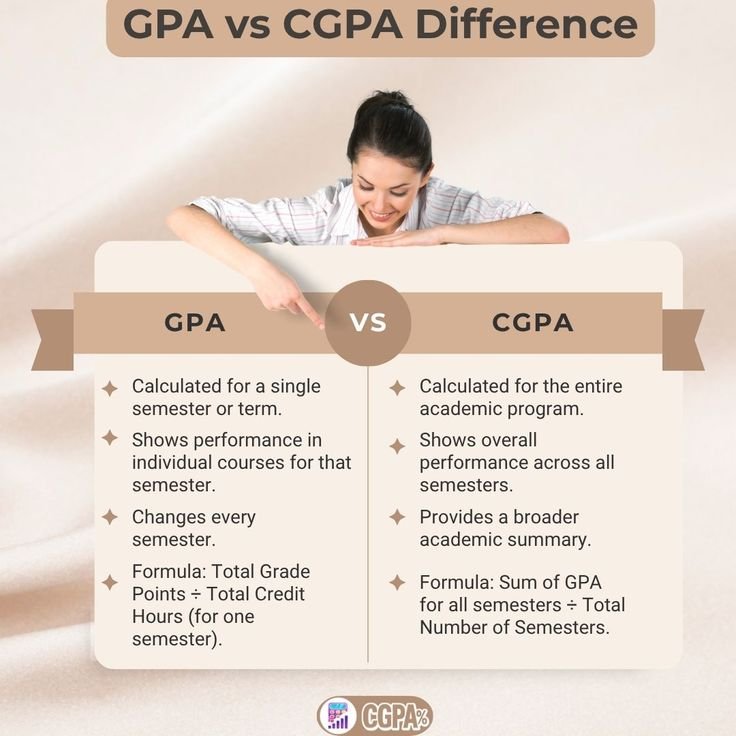
For Indian students applying to American universities, and for US-based applicants trying to make sense of an Indian transcript, one question comes up constantly: how do these three systems — US GPA, Indian CGPA, and Indian percentage — actually relate to each other? The honest answer is that they don’t map onto each other perfectly, because each system was built around a different educational philosophy, a different grading structure, and a different set of assumptions about what academic evaluation should reward. This guide breaks down exactly how these three systems differ, walks through the approximate conversion formulas commonly used between them, and explains where self-calculated conversions fall short of what a formal application actually requires.
Three Systems, Three Different Philosophies
Before diving into formulas, it helps to understand what each system is actually designed to measure, since the differences in philosophy explain why exact conversion is so difficult.
- Percentage measures the raw proportion of marks scored out of the maximum possible marks — a direct, absolute reflection of exam and coursework performance.
- CGPA groups percentage-equivalent performance into broader grade bands, reducing the emphasis on marginal mark differences and rewarding consistency across an academic year or program.
- US GPA is built from individual course letter grades, often incorporating continuous assessment, class participation, and sometimes course difficulty (through weighted GPA systems), producing a philosophy closer to CGPA’s holistic approach but with its own distinct scale and grading conventions.
Because these three systems reward slightly different things, even a mathematically “correct” conversion between them is always an approximation, not an exact translation of underlying ability.
Understanding the US GPA System in Detail
The United States GPA system is built on a 4.0 scale, where individual letter grades are assigned a fixed grade point value, most commonly A = 4.0, A- = 3.7, B+ = 3.3, B = 3.0, B- = 2.7, C+ = 2.3, C = 2.0, C- = 1.7, D = 1.0, and F = 0.0. A student’s overall GPA is the average of these values across every completed course, often weighted by the credit hours assigned to each course, similar in structure to how Indian universities calculate a credit-weighted CGPA from individual subject grade points.
One notable difference from the Indian system is the existence of weighted GPA, used by many US high schools for advanced or honors coursework. Under a weighted system, an A in an Advanced Placement (AP) or honors course might be assigned 5.0 points instead of the standard 4.0, allowing a student’s GPA to exceed the traditional 4.0 ceiling. This has no direct equivalent in the Indian CGPA system, where the maximum achievable grade point is fixed at 10 regardless of subject difficulty, and is an important distinction to keep in mind when comparing GPA figures across applicants.
Understanding the Indian CGPA System in Detail
Indian CGPA, most commonly used on a 10-point scale, is built from grade points assigned to marks-based performance bands. A student’s CGPA is the average of these grade points across all subjects, weighted by credit hours at the university level, and cumulative across every semester of a program. Unlike the US system, there is no equivalent to “weighted GPA” for harder subjects — every subject contributes to CGPA purely based on its credit hours, not its perceived difficulty relative to other courses.
Understanding the Indian Percentage System in Detail
Percentage remains the most literal and universally understood metric of the three, expressing a student’s marks scored as a direct proportion of the maximum possible marks. It has no equivalent grade-banding or holistic weighting built in — a 91% and a 90% are treated as genuinely different figures, unlike a CGPA system where both might fall into the same grade band.
The Standard Formula: Indian CGPA to US GPA
The most commonly used approximate conversion between Indian CGPA and US GPA is a simple proportional formula:
GPA ≈ (CGPA ÷ 10) × 4
Worked Example
- Start with your CGPA: 8.6
- Divide by 10: 8.6 ÷ 10 = 0.86
- Multiply by 4: 0.86 × 4
- Result: approximately 3.44 GPA
The Standard Formula: Indian Percentage to US GPA
For students converting directly from percentage rather than CGPA, a commonly used approximate formula is:
GPA ≈ Percentage ÷ 25
Worked Example
- Start with your percentage: 88%
- Divide by 25: 88 ÷ 25
- Result: approximately 3.52 GPA
Reverse Conversion: US GPA to Indian CGPA and Percentage
Students moving in the opposite direction — translating a US GPA into Indian terms for a job or admissions application within India — can use the same formulas rearranged:
CGPA ≈ (GPA ÷ 4) × 10
Percentage ≈ GPA × 25
Worked Example: GPA to CGPA
- Start with your GPA: 3.7
- Divide by 4: 3.7 ÷ 4 = 0.925
- Multiply by 10: 0.925 × 10
- Result: approximately 9.25 CGPA
Worked Example: GPA to Percentage
- Start with your GPA: 3.7
- Multiply by 25: 3.7 × 25
- Result: approximately 92.5%
Side-by-Side Comparison Table
To see how these three systems line up across a range of common performance levels, here’s an approximate side-by-side comparison using the proportional formulas above:
- CGPA 10.0 / Percentage 95% / GPA 4.0 — Outstanding performance band across all three systems
- CGPA 9.0 / Percentage 85.5% / GPA 3.6 — Excellent performance band
- CGPA 8.0 / Percentage 76% / GPA 3.2 — Very good performance band
- CGPA 7.0 / Percentage 66.5% / GPA 2.8 — Good performance band
- CGPA 6.0 / Percentage 57% / GPA 2.4 — Above average performance band
- CGPA 5.0 / Percentage 47.5% / GPA 2.0 — Average performance band
These figures are approximate orientation points, not exact certified equivalences, since each system’s underlying grading philosophy differs in ways a single proportional formula can’t fully capture.
Why a Perfect Numeric Match Doesn’t Exist
Several structural differences explain why these three systems resist a truly precise conversion:
- Grade banding in CGPA compresses a wide range of marks into a single grade point, meaning two students with different actual performance can share the same CGPA, which then converts identically even though their true percentage may have differed by several points.
- Weighted GPA in the US system allows some students to exceed the standard 4.0 ceiling for advanced coursework, a concept with no direct parallel in the Indian CGPA structure.
- Institution-specific grading distributions mean that a “B” at one US university might represent a different percentage range than a “B” at another, just as different Indian universities apply different CGPA-to-percentage formulas.
- Continuous assessment weighting varies significantly between US courses and Indian semester systems, meaning the underlying components that build up to a final grade aren’t always directly comparable.
How US Universities Evaluate Indian CGPA and Percentage
Admissions committees at American universities generally fall into a few broad approaches when reviewing an Indian applicant’s transcript:
- Direct interpretation — Larger universities with significant experience reviewing Indian applicants often interpret CGPA or percentage directly, without requiring a converted GPA figure, since their admissions staff are already familiar with Indian grading conventions.
- Self-reported conversion — Some application portals ask students to self-report an approximate GPA equivalent using a standard proportional formula, purely for internal sorting and comparison purposes.
- Formal credential evaluation — Particularly for competitive programs or when an official GPA figure is required for scholarship or visa purposes, universities often require a report from a recognized credential evaluation service such as World Education Services (WES) or Educational Credential Evaluators (ECE).
Because these approaches vary so significantly by institution, it’s always worth checking your specific target university’s international admissions page rather than assuming a single standard approach applies universally.
What Credential Evaluation Services Actually Do
Unlike a simple proportional formula, credential evaluation organizations review a student’s actual transcript, institution accreditation, and — in some cases — the specific grading distribution of their home university, before issuing an official GPA-equivalent report. This process accounts for nuances a general formula can’t capture, such as whether a particular Indian university tends to award higher or lower CGPA relative to actual student performance compared to national norms. For scholarship applications, visa processes, and highly competitive graduate admissions, these formal reports often carry significantly more weight than a self-calculated conversion.
Step-by-Step: Preparing Your Academic Record for a US Application
- Gather your original CGPA or percentage figures directly from your official transcript or mark sheet
- Check your target university’s international admissions page for any specific stated conversion preference
- Calculate an approximate GPA equivalent using the proportional formulas in this guide for your own planning and shortlisting purposes
- Determine whether your target university requires a formal credential evaluation report, and if so, submit your transcripts to a recognized evaluation service well ahead of your application deadline
- Include both your original CGPA or percentage and your approximate GPA equivalent on informal materials like a resume, for maximum clarity to any reader
How US Employers and Graduate Programs View Indian Grades
Employers and graduate admissions committees in the United States vary in how familiar they are with Indian grading conventions. Larger companies and universities with established recruiting pipelines from Indian institutions tend to interpret CGPA and percentage figures fairly directly, having reviewed many similar transcripts before. Smaller employers or less internationally focused programs may lean more heavily on a self-reported GPA conversion simply because it’s the metric they’re most familiar with evaluating. In either case, providing both your original figure and an approximate GPA conversion tends to give the reader the clearest possible picture, regardless of their prior familiarity with the Indian system.
Common Misconceptions About GPA, CGPA, and Percentage
- “A 4.0 GPA is exactly equivalent to a 10.0 CGPA or 100% percentage.” In proportional terms this is often assumed, but since CGPA rarely converts to a full 100% percentage under standard formulas like CGPA × 9.5, the three “maximum” values don’t actually represent identical underlying performance.
- “There’s one universal, officially recognized conversion formula.” As covered throughout this guide, no single formula is centrally mandated across every Indian university or every US institution — the proportional formulas here are widely used approximations, not certified standards.
- “Weighted GPA and Indian CGPA work the same way.” They don’t. Weighted GPA specifically adjusts for course difficulty in a way the Indian CGPA system does not, which can make direct numeric comparison between a US student’s weighted GPA and an Indian student’s CGPA especially imprecise.
- “A converted GPA is as authoritative as an official transcript.” A self-calculated conversion is a helpful estimate for planning purposes, but formal applications frequently require either the original transcript or a certified credential evaluation report instead.
Common Mistakes to Avoid
- Assuming a single proportional formula is precise enough for a formal, high-stakes application without checking whether a credential evaluation is actually required
- Converting percentage to GPA and then separately converting CGPA to GPA, and expecting both results to match exactly, when in practice small formula differences can produce slightly different figures
- Ignoring weighted GPA distinctions when comparing a US applicant’s transcript against an Indian CGPA-based transcript
- Submitting a self-calculated GPA figure when a university’s application portal specifically requests an official evaluation report
- Treating the side-by-side comparison table in this guide as an exact certified equivalence rather than a general orientation reference
Tips for Indian Students Applying to US Institutions
- Always check your target university’s specific stated requirements before assuming a standard proportional formula will be accepted
- Keep your original transcript and mark sheet ready, since many universities prefer reviewing the original figures directly rather than a self-converted GPA
- Budget sufficient time for a formal credential evaluation if your target program requires one, since these reports can take several weeks to process
- Use the approximate formulas in this guide for early-stage planning and university shortlisting, not as your final submitted figure
- Reach out directly to the international admissions office if you’re unsure whether a self-calculated GPA or an official evaluation is expected
Frequently Asked Questions
Is there an official, government-recognized formula for converting CGPA to US GPA?
No. The proportional formulas covered in this guide are widely used approximations, not a formula certified by any single Indian or American educational authority. Different universities and credential evaluators may apply their own specific methodology.
Why does my converted GPA seem lower than what my university abroad expects?
This can happen because proportional conversion formulas don’t account for institution-specific grading distributions or weighted GPA adjustments, both of which can shift the expected range at your target university. Checking their specific international admissions guidance often clarifies this gap.
Do I need a credential evaluation for every US application?
Not always. Some universities interpret Indian CGPA or percentage directly, while others specifically require a formal credential evaluation report, particularly for scholarship, visa, or highly competitive program applications. Always check your specific institution’s stated requirements.
Can weighted GPA students in the US directly compare their GPA to Indian CGPA?
Not precisely, since weighted GPA can exceed the standard 4.0 scale for advanced coursework, a concept with no equivalent adjustment in the Indian CGPA system. A direct numeric comparison in this case is even less precise than the standard unweighted conversion.
Which is more useful on an international resume — CGPA, percentage, or converted GPA?
Including your original CGPA or percentage alongside an approximate GPA conversion generally gives readers unfamiliar with either system the clearest possible picture, without relying entirely on a single converted figure.
Final Thoughts
US GPA, Indian CGPA, and Indian percentage are three genuinely different systems built on different grading philosophies, and while proportional formulas offer a useful approximate bridge between them, none of the three can be perfectly translated into another through simple math alone. For everyday comparison, planning, and shortlisting universities, the formulas and comparison table in this guide will serve you well. For formal, high-stakes applications — particularly scholarships, visas, or competitive graduate admissions — always check whether your target institution requires an official credential evaluation report rather than relying solely on a self-calculated conversion.