
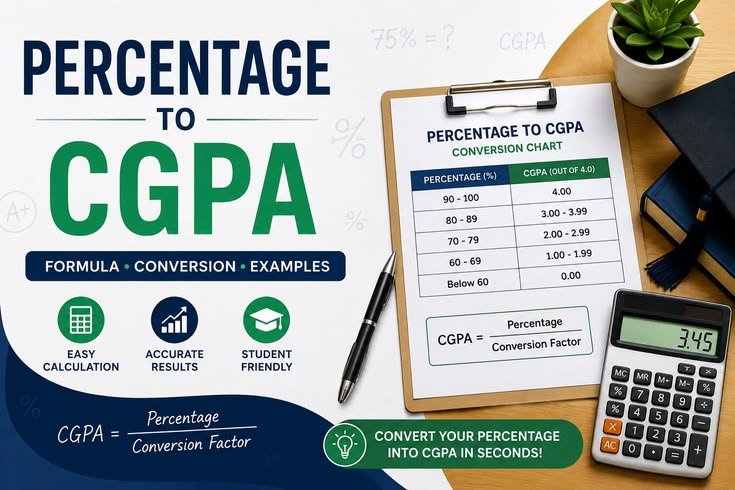
Every year, thousands of students search for one simple thing: an accurate way to convert their CGPA into a percentage. Whether you’re checking a board result, filling out a job application, or preparing documents for a university admission, this guide walks you through every formula you need, explained in plain language with real worked examples.
What Is CGPA?
CGPA stands for Cumulative Grade Point Average. It is a single number, usually between 0 and 10, that summarizes a student’s overall academic performance across an entire academic year or full program. Instead of adding up raw marks the way a percentage does, CGPA is built from grade points — each subject is assigned a grade, and each grade corresponds to a fixed point value. The final CGPA is the average of those points, often weighted by credit hours at the university level.
What Is Percentage?
Percentage represents the proportion of total marks scored out of the maximum possible marks, expressed as a number out of 100. It remains the metric most commonly requested by employers, government job applications, and many university admission portals, which is exactly why converting CGPA into percentage is still such a frequently needed calculation.
Why Do You Need to Convert CGPA to Percentage?
Not every form or portal accepts CGPA directly. Some of the most common situations where a percentage figure is specifically required include:
- Government job applications and competitive exams that set a minimum percentage eligibility cutoff
- Campus placement drives where recruiters compare candidates from different universities on a single standardized metric
- Scholarship applications with percentage-based eligibility criteria
- Study-abroad applications where the receiving institution requests a percentage-equivalent transcript
- Resume building, where listing a percentage alongside CGPA gives immediate clarity to any reader
The Standard CGPA to Percentage Formula
The most widely used and most commonly searched formula for converting CGPA to percentage on a 10-point scale is:
Percentage = CGPA × 9.5
This formula was popularized by CBSE for Class 10 board results and has since been informally adopted as a general benchmark by many other boards and universities, even where it isn’t the officially mandated formula for that specific institution.
Worked Example
If your CGPA is 8.4, your percentage would be calculated as follows:
- Start with your CGPA: 8.4
- Multiply by the standard factor: 8.4 × 9.5
- Result: 79.8%
Why 9.5 and Not a Simple 10?
A common point of confusion is why the multiplier isn’t a straightforward 10. The 9.5 figure exists because historical analysis of student scoring patterns found that even top-performing students rarely achieved a perfect 100% under the older percentage system, even when they earned the highest possible CGPA band. To keep the conversion realistic, 9.5 was chosen as a more representative multiplier instead of a flat 10.
Alternative Formulas Used by Different Institutions
Not every university uses the 9.5 multiplier. Some of the most common alternative formulas include:
- Simple 10x multiplier: Percentage = CGPA × 10, used by several universities that treat CGPA on a direct proportional scale
- Offset formula: Percentage = (CGPA − 0.75) × 10, used by certain autonomous colleges that build in a small downward adjustment before scaling
- Weighted-addition formula: a fixed multiplier combined with an added constant, used by some universities where the CGPA-to-percentage relationship isn’t purely multiplicative
Because these formulas genuinely differ, it’s always worth confirming your own institution’s official conversion circular before submitting a converted percentage on any formal application.
Converting a 4.0 GPA Scale to Percentage
Students on the American-style 4.0 scale use a different approximate formula:
Percentage ≈ GPA × 25
Worked Example
- Start with your GPA: 3.6
- Multiply by the conversion factor: 3.6 × 25
- Result: approximately 90%
This is treated as an approximation rather than an exact science, since most American institutions don’t issue an official percentage equivalent — GPA is generally considered a complete metric on its own within that system.
Converting Percentage Back to CGPA
The reverse calculation is just as straightforward. Using the standard 9.5-based formula:
CGPA = Percentage ÷ 9.5
Worked Example
- Start with your percentage: 82%
- Divide by the standard factor: 82 ÷ 9.5
- Result: approximately 8.63 CGPA
Step-by-Step: How to Convert Your CGPA Accurately
- Identify your exact grading scale — 10-point, 7-point, 5-point, or 4.0 — before applying any formula
- Check whether your board or university publishes a specific conversion circular, since formulas can differ meaningfully between institutions
- Apply the correct formula, carrying your CGPA to at least two decimal places to avoid early rounding errors
- Round only your final percentage result, not the CGPA value used in the calculation
- Keep a note of the exact formula used, especially if you’re submitting the figure on a formal application
University-Wise Formula Differences
Because there is no single national authority governing grading policy, different universities apply different formulas. Engineering universities commonly use a direct 10x multiplier, some autonomous colleges apply an offset formula, and certain universities use entirely unique weighted formulas specific to their own grading circulars. Always cross-check with your registrar’s office before relying on a generic multiplier for a high-stakes application such as a government job form or a visa document.
Common Mistakes to Avoid
- Using the wrong multiplier for your specific institution instead of checking the official formula
- Confusing a single semester’s SGPA with your overall cumulative CGPA before converting
- Rounding your CGPA too early in the calculation, which can shift your final percentage
- Applying a 10-point scale formula to a 4.0 GPA score, which produces a meaningless result
Final Thoughts
There is no single universal formula for converting CGPA to percentage, and that’s exactly why understanding the reasoning behind each formula matters as much as the final number itself. Whether you’re using the standard 9.5 multiplier, a straightforward 10x calculation, or an institution-specific offset formula, always confirm the figure against your own university’s official circular before using it on a formal application. Use the calculator on this page to get an instant, accurate result based on your specific grading scale and institution.