
If you’re a university student on a semester system, you’ve probably noticed that your mark sheet shows two different numbers: an SGPA for each individual semester, and a CGPA that’s supposed to represent your overall academic record. Combining several semesters’ SGPA into a single, accurate CGPA isn’t as simple as averaging the numbers — and getting it wrong can quietly throw off your placement resume, your postgraduate application, or your eligibility for a scholarship. This guide breaks down exactly how SGPA and CGPA relate to each other, the correct credit-weighted formula for combining them, and several fully worked examples so you can calculate your own CGPA with confidence.
What Is SGPA?
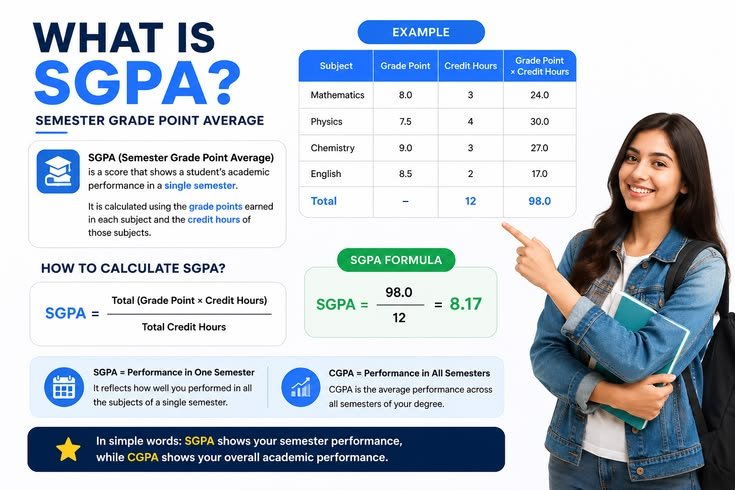
SGPA stands for Semester Grade Point Average. It is a single number, typically on a 10-point scale, that reflects your academic performance within one specific semester. Every subject you take during that semester is assigned a grade point based on your performance, and those grade points are combined — usually weighted by each subject’s credit hours — to produce your SGPA for that term. A new SGPA is calculated at the end of every semester, giving you a fresh, term-specific snapshot of your performance.
What Is CGPA?
CGPA, or Cumulative Grade Point Average, is the running average of your academic performance across every semester you’ve completed so far, not just the most recent one. Rather than being a simple arithmetic average of your SGPA scores, your CGPA is calculated using the total grade points and total credit hours earned across all semesters combined. This distinction matters more than most students realize, and it’s the single biggest source of error when converting SGPA into CGPA manually.
Why You Can’t Just Average Your SGPA Scores
A common mistake is assuming that CGPA is simply the arithmetic mean of all your SGPA values — add them up, divide by the number of semesters, and you’re done. This approach ignores a crucial factor: not every semester carries the same number of total credit hours. If one semester includes more subjects, heavier lab components, or additional credit-bearing electives, it carries proportionally more weight in your final CGPA than a lighter semester with fewer credits. Simply averaging your SGPA values treats every semester as equally weighted, which can produce a noticeably inaccurate CGPA, especially if your credit load varied across semesters.
The Correct Credit-Weighted CGPA Formula
To calculate CGPA accurately, universities use a credit-weighted formula that accounts for the total credit hours completed in each semester. The formula looks like this:
CGPA = Σ (SGPA of each semester × Total Credit Hours of that semester) ÷ Σ (Total Credit Hours across all semesters)
In plain terms: multiply each semester’s SGPA by that semester’s total credit hours, add up these weighted values across every semester, and then divide by the total number of credit hours completed across your entire program so far.
Step-by-Step: How to Calculate CGPA from Multiple Semesters
- Gather your SGPA for every completed semester from your official mark sheets or transcript
- Note down the total credit hours associated with each of those semesters
- Multiply each semester’s SGPA by its corresponding credit hours
- Add together all of these weighted values across every semester
- Add together the total credit hours across all semesters separately
- Divide the total weighted value by the total credit hours to get your cumulative CGPA
- Round your final CGPA to two decimal places, matching the format typically used on official transcripts
Worked Example: Combining Two Semesters
Let’s walk through a simple two-semester example to see the formula in action.
- Semester 1: SGPA of 8.2, with 24 total credit hours
- Semester 2: SGPA of 8.6, with 22 total credit hours
First, calculate the weighted grade points for each semester:
- Semester 1: 8.2 × 24 = 196.8
- Semester 2: 8.6 × 22 = 189.2
Next, add the weighted values together, and separately add the total credit hours:
- Total weighted value: 196.8 + 189.2 = 386.0
- Total credit hours: 24 + 22 = 46
Finally, divide the total weighted value by the total credit hours:
- CGPA = 386.0 ÷ 46
- Result: CGPA of approximately 8.39
Notice that this result is slightly different from a simple average of 8.2 and 8.6, which would have given 8.4. The small difference comes directly from the credit-hour weighting, since Semester 1 carried more credit hours and therefore had a slightly larger influence on the final CGPA.
Worked Example: Combining Four Semesters
The same method applies no matter how many semesters you’re combining. Here’s a four-semester example:
- Semester 1: SGPA of 7.8, with 23 credit hours
- Semester 2: SGPA of 8.1, with 24 credit hours
- Semester 3: SGPA of 8.5, with 22 credit hours
- Semester 4: SGPA of 8.9, with 21 credit hours
Calculate the weighted value for each semester:
- Semester 1: 7.8 × 23 = 179.4
- Semester 2: 8.1 × 24 = 194.4
- Semester 3: 8.5 × 22 = 187.0
- Semester 4: 8.9 × 21 = 186.9
Add the weighted values and total credit hours:
- Total weighted value: 179.4 + 194.4 + 187.0 + 186.9 = 747.7
- Total credit hours: 23 + 24 + 22 + 21 = 90
Divide to get the final CGPA:
- CGPA = 747.7 ÷ 90
- Result: CGPA of approximately 8.31
How SGPA Itself Is Calculated from Subject Grades
To fully understand the process, it helps to see how SGPA is built in the first place, since it follows the same credit-weighted logic at the subject level. Suppose a student has four subjects in one semester:
- Subject A: Grade Point 9, Credit Hours 4
- Subject B: Grade Point 8, Credit Hours 3
- Subject C: Grade Point 7, Credit Hours 3
- Subject D: Grade Point 9, Credit Hours 2
Multiply each grade point by its credit hours:
- Subject A: 9 × 4 = 36
- Subject B: 8 × 3 = 24
- Subject C: 7 × 3 = 21
- Subject D: 9 × 2 = 18
Add the weighted grade points and total credit hours:
- Total weighted grade points: 36 + 24 + 21 + 18 = 99
- Total credit hours: 4 + 3 + 3 + 2 = 12
Divide to calculate SGPA:
- SGPA = 99 ÷ 12
- Result: SGPA of 8.25
This same subject-level calculation repeats every semester to produce a new SGPA, which then feeds into your overall CGPA using the multi-semester formula covered earlier.
Converting Your Final CGPA into Percentage
Once you’ve calculated your cumulative CGPA across all completed semesters, you may still need to convert it into a percentage for a job application, scholarship form, or postgraduate admission portal. The standard formula is:
Percentage = CGPA × 9.5
Some universities use a straightforward 10x multiplier or an offset-based formula instead, so it’s worth confirming which formula your specific institution applies before finalizing a converted percentage. You can also use our CGPA to Percentage Calculator directly once you have your cumulative CGPA in hand.
What to Do If Your Semesters Had Backlog or Reappear Subjects
Backlog subjects add an extra layer of complexity to CGPA calculation. In most systems, the grade point earned in the semester a backlog subject is eventually cleared is the one factored into your cumulative CGPA, rather than the original failing attempt. However, the exact policy on how backlog subjects are weighted into your credit hour total can vary between universities, so it’s worth confirming your institution’s specific rule if you have any backlog subjects factored into your record.
Why Credit Hours Matter So Much in This Calculation
Credit hours exist to reflect the relative workload and importance of each subject. A lab-heavy or major core subject often carries more credit hours than a lighter elective, meaning strong or weak performance in that subject has a proportionally larger effect on both your SGPA and your overall CGPA. Understanding this helps explain why two students with seemingly similar semester performance can end up with noticeably different SGPA or CGPA figures, simply based on how their specific subjects were weighted.
Common Mistakes Students Make When Calculating CGPA
- Simply averaging SGPA values across semesters instead of using a credit-weighted formula
- Forgetting to include a semester’s credit hours entirely, leading to an inaccurate weighted total
- Mixing up the SGPA of a single semester with the cumulative CGPA when filling out an application
- Rounding intermediate SGPA values too early, which compounds small errors across the final calculation
- Not accounting for backlog or reappear subjects correctly when tallying credit hours
- Assuming every semester carries identical total credit hours without checking their actual transcript
Tips for Tracking Your CGPA Across Multiple Semesters
- Keep a running spreadsheet or note of your SGPA and total credit hours for every completed semester
- Recalculate your cumulative CGPA after each new semester rather than waiting until your final year
- Cross-check your self-calculated CGPA against your official transcript whenever it’s issued, to catch any discrepancies early
- Use our SGPA to CGPA calculator above to avoid manual calculation errors, especially once you’re combining several semesters at once
- If you notice a mismatch between your own calculation and your official transcript, contact your examination department for clarification rather than assuming your own math is correct
Why This Matters for Placement Season and Applications
For students preparing resumes ahead of campus placement drives, having an accurate, up-to-date CGPA is essential, since recruiters frequently use it as a baseline eligibility filter before shortlisting candidates. Waiting until your final semester to calculate your cumulative CGPA for the first time increases the risk of a careless error going unnoticed until it actually matters. Tracking your CGPA semester by semester, using the correct credit-weighted formula, gives you an accurate, reliable figure well before you need to submit it anywhere.
Frequently Asked Questions
Can I just average my SGPA scores if all my semesters had the same credit hours?
In that specific case, a simple average would produce the same result as the credit-weighted formula, since equal credit hours across every semester effectively cancel out the weighting factor. However, it’s still safer to use the full formula, since even a single semester with a different credit load will throw off a simple average.
Does my CGPA reset each year, or does it carry over my entire degree?
CGPA is cumulative across your entire program, not reset each year. Every new semester’s SGPA and credit hours are added into the running total, meaning your CGPA reflects your complete academic record from your first semester through your most recent one.
What if two semesters have different maximum possible credit hours?
This is common and exactly why the credit-weighted formula exists — it automatically accounts for semesters with different total credit loads, ensuring each semester contributes proportionally to your final CGPA based on its actual weight rather than being treated as equal to every other semester.
Is SGPA ever used instead of CGPA on official documents?
Some internal semester-specific documents, like a single-term mark sheet, will display SGPA alone. However, most formal external documents — resumes, final transcripts, and degree certificates — typically report cumulative CGPA, since it represents your complete academic performance rather than just one term.
Final Thoughts
Combining your semester-wise SGPA into an accurate cumulative CGPA comes down to one key principle: always weight each semester by its total credit hours rather than treating every semester as equal. Whether you’re tracking your progress semester by semester or calculating your final CGPA ahead of graduation, the credit-weighted formula covered in this guide will give you a reliable, transcript-accurate figure. For an instant calculation without manual math, use the SGPA to CGPA calculator above — simply enter each semester’s SGPA and credit hours, and get your cumulative CGPA in seconds.